

Accident insurance and health insurance serve different purposes. One provides cash for unexpected injuries, while the other covers everyday and long-term medical care. Understanding the difference helps you choose the right coverage or combine both for stronger protection.
Accident Insurance vs Health Insurance: Understanding the Differences and Which One Is Right for You
Accident insurance and health insurance often get lumped together, but they serve very different roles in protecting your health and your wallet. Many people assume accident insurance is a cheap replacement for health insurance, but they actually serve very different functions. This guide breaks down what each type of coverage does, how they differ, what they cost, and how to choose the right setup for your lifestyle and budget.
Accident insurance does not replace health insurance plans. Rather, it is designed to work alongside it.
At Champion Benefit Advisors, we specialize in helping individuals, families, and small business owners understand their benefits and make confident choices.
Key highlights
Accident insurance pays you cash after an injury. Low cost, supplemental — not a replacement for health insurance.
Health insurance covers everything: illness, preventive care, prescriptions, chronic conditions, and emergencies.
Best of both — use health insurance as your foundation. Add accident insurance to fill cost gaps when injuries happen.
- Accident insurance pays a lump-sum directly to you — use it for bills, lost income, childcare, or transportation.
- Health insurance pays your providers and covers the full spectrum of medical needs, from checkups to surgery.
- Accident insurance is especially valuable if you have a high-deductible health plan (HDHP), work in a physically demanding job, or have active kids in sports.
- Cost difference is significant: accident insurance often runs under $20/month vs. $300–$600+ for health insurance.
- Accident insurance does not cover illness, prescriptions, preventive care, or chronic conditions — only injuries from accidents.
- Many families combine both: health insurance for everyday and long-term care, accident insurance for unexpected injury costs
In this article
- Accident insurance vs. health insurance at a glance
- What is accident insurance?
- What does accident insurance cover?
- What is health insurance?
- What does health insurance cover?
- Key differences between the two
- Cost comparison
- Flexibility and terms
- When should you choose each one?
- When accident insurance makes sense
- When health insurance is essential
- Can you combine both?
- What’s the best option for you?
- Frequently asked questions
Accident Insurance vs Health Insurance at a Glance
Before we dig into the details, here’s a quick side-by-side comparison.
| Feature | Accident Insurance Policy | Health Insurance Policy |
|---|---|---|
| Coverage | Accident-only medical + related costs | Preventive, illness, accidents, hospitalization |
| Cost | Low, supplemental | Higher, core medical |
| Payout | Lump-sum cash | Pays providers directly |
| Flexibility | Add-on, short-term | Annual, regulated |
| Best For | High-risk jobs, athletes, budget-conscious | Comprehensive care, families, chronic care |
A Quick Overview of Accident Insurance
Accident insurance plans are a supplemental policy that pays cash benefits directly to you if you’re injured due to an accident. Unlike health insurance, which pays the medical provider, accident insurance gives you a lump-sum payout you can use however you need: medical bills, lost income, childcare, transportation, or even rent.
Champion Benefit Advisors has guided thousands of workers in high-risk fields, from construction, warehouse, landscaping, delivery, and more, on how accident insurance can be a smart, cost-effective add-on to their core medical coverage.
What Does Accident Insurance Cover?
Personal accident insurance typically includes benefits for:
- ER or urgent care visits
- Ambulance transportation
- Broken bones
- Dislocations
- Surgeries
- Follow-up appointments
- Physical therapy
- Hospital stays due to an accident
It may also help with non-medical costs tied to accidents, such as childcare or transportation.
Benefits of Accident Insurance
- Quick financial relief: Lump-sum cash benefits help you cover bills immediately.
- Helps offset deductibles: Especially helpful with high-deductible health plans (HDHPs).
- Affordable supplemental coverage: Policies typically cost much less than full health insurance.
- Flexible use: Spend it on anything related to your recovery (or the bills that pile up because of it).
A Quick Overview of Health Insurance
Health insurance is your main source of medical protection. It covers illnesses, preventive care, prescriptions, chronic conditions, emergencies, and accidents, essentially everything needed to maintain long-term health.
What Does Health Insurance Cover?
- Wellness visits
- Vaccines
- Screenings and labs
- Prescription medications
- Hospitalizations
- Surgeries
- Mental health services
- Chronic disease care (asthma, diabetes, heart conditions)
- Accidents and emergencies
Benefits of Health Insurance
- Broad, comprehensive protection for everyday and long-term care
- Financial safety net for expensive medical situations
- ACA(Affordable Care Act) compliant coverage and preventive benefits
- Essential for protecting families and dependents
Key Differences Between Health and Accident Insurance
Quick Snapshot: What Each Policy Actually Covers
- Accident Insurance: Pays cash benefits for injury-related expenses only — think broken bones, ER visits, ambulance rides, and follow-up care.
- Traditional Health Insurance: Covers the full range of medical needs — preventive care, illnesses, prescriptions, chronic conditions, hospitalizations, and accidents.
Remember: Accident insurance is a helpful add-on, but it doesn’t replace health insurance.
Pro Tip: Think in Scenarios, Not Just Features
Understanding the difference between accident insurance and health insurance becomes much clearer when you picture real-life situations.
Broken leg from a slip at home:
- Accident insurance gives you a cash benefit you can use however you need.
- Health insurance covers the medical treatment once you hit your deductible.
New diagnoses like diabetes:
- Accident insurance doesn’t apply.
- Health insurance covers labs, medications, and long-term care.
A construction worker falls from a ladder:
- Accident insurance provides fast cash to offset lost income or immediate expenses.
- Health insurance covers the hospital stay, surgery, and rehabilitation.
An office worker gets the flu:
- Accident insurance doesn’t pay.
- Health insurance covers doctor visits, testing, and prescriptions.
Accident insurance is all about the unexpected “ouch” moment; health insurance covers everything else that life throws your way.
Cost Comparison
Health insurance costs more because it covers more, while accident insurance tends to be a small, supplemental cost.
Typical ranges:
- Accident insurance: Often under $20/month (varies by provider and benefit level).
- Health insurance: Premiums often range from $300–$600+/month, depending on state, age, health, and plan type.
Accident insurance is budget-friendly; health insurance is a core investment.
Flexibility and Terms
Accident insurance:
Health insurance:
- Can be added anytime
- Often renewable month-to-month
- Works well as a supplemental policy
- Follows annual enrollment deadlines
- Regulated by the Affordable Care Act
- Designed as foundational health protection
Think of health insurance as your main coverage with an assist from accident insurance that gets to work when life gets hectic.
When Should You Choose Accident Insurance vs Health Insurance?
Accident Insurance Might Be a Better Option If…
Accident insurance shines in specific situations, especially when it’s used as an add-on.
| Scenario | Why Accident Insurance Helps |
|---|---|
| You have a high-deductible health plan (HDHP) | Accident insurance can provide a lump-sum payment to help cover deductibles and co-pays that your health insurance won’t pay until you hit your out-of-pocket maximum. |
| You’re active or work in a high-risk job (e.g., construction, warehouse, athletics) | Provides extra protection against sudden accidents, ER visits, and recovery costs that are more likely in physically demanding or risky roles. |
| You want backup for unexpected costs | Accident benefits can be used for non-medical expenses too, such as transportation, childcare, or household bills while you recover. |
| You need affordable supplemental coverage | Accident insurance usually has lower premiums than health insurance and can be a cost-effective way to boost financial protection. |
Many of our clients with high-deductible health plans choose accident insurance coverage as a practical way to offset their out-of-pocket expenses.
Health Insurance Might Be Better If…
Health insurance is the backbone of long-term financial and physical wellness. Families with children, dependents, or chronic care needs consistently rely on health insurance as their financial safety net.
| Scenario | Why Health Insurance Helps |
|---|---|
| You need coverage for illnesses, chronic care, and preventive visits | Health insurance covers far more than accidents—everything from checkups and prescriptions to long-term conditions like diabetes or asthma. |
| You want financial protection from ongoing or unexpected medical bills | A single hospital stay or surgery can cost tens of thousands of dollars. Health insurance shields you from overwhelming out-of-pocket expenses. |
| You have dependents or family responsibilities | Health insurance provides a safety net for spouses, children, or other dependents, ensuring they have access to care if something happens to you. |
| You’re seeking long-term security and peace of mind | Comprehensive coverage gives you confidence that routine care and emergencies are handled without draining your savings. |
Can You Combine Both?
Yes! And many families do. Health insurance provides comprehensive medical protection. Accident insurance adds a layer of financial backup when sudden injuries happen.
Examples where combining both is ideal:
- Parents with kids in sports: Accident insurance helps cover ER visits for sprains or broken bones.
- Families with high-deductible health plans: Accident insurance helps bridge the gap until you meet your out-of-pocket max.
- Active adults or athletes: Provides peace of mind when injuries are more likely.
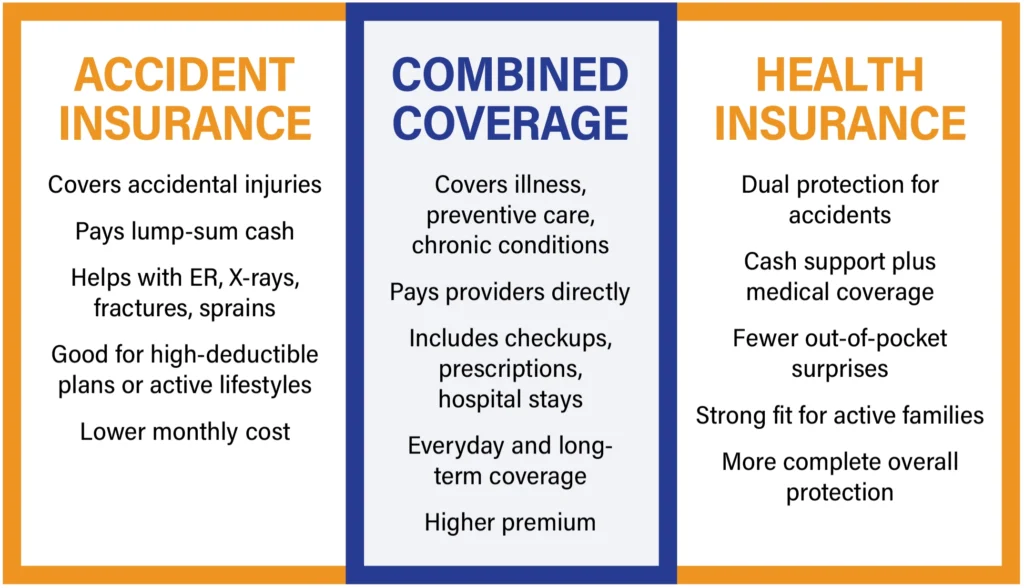
Health insurance is your foundation for everyday and long-term care, while accident insurance adds a financial safety net for sudden injuries. Together, they give you more complete protection.
Many of the families we work with combine both: health insurance as the foundation, with accident insurance to help cover kids’ sports injuries or ER visits that come with active lifestyles.
What Is the Best Option for You?
Choosing between accident insurance and health insurance really depends on what your day-to-day life looks like. Your lifestyle, risk level, health needs, family setup, and budget all shape what kind of protection makes the most sense.
If you want everyday coverage and long-term stability, health insurance is essential. If you want extra financial protection for life’s unexpected “oops” moments, accident insurance is an affordable add-on.
| Feature | Accident Insurance | Health Insurance | Combined Coverage |
|---|---|---|---|
| Coverage | Accident-related injuries and related costs | Illnesses, preventive care, accidents, hospitalization | Full spectrum: illnesses + preventive + accident cash benefits |
| Cost | Lower premiums, supplemental | Higher premiums, core coverage | Balanced: higher protection with manageable costs |
| Payout | Lump-sum cash benefits | Pays providers directly | Both: cash for expenses + provider payments |
| Best For | High-deductible plans, active lifestyles, high-risk jobs | Families, dependents, long-term financial protection | Families or individuals wanting complete safety net |
| Key Advantage | Quick relief for the financial burden caused by accident expenses | Comprehensive health protection | Strongest overall coverage and peace of mind |

With decades of experience helping individuals, families, and small businesses, Champion Benefit Advisors can guide you to the right coverage mix for your budget and goals.
Contact Champion Benefit Advisors today to build the coverage mix that works for you.
Frequently Asked Questions about Accident vs Health Insurance
No. Accident insurance is supplemental and does not meet ACA health insurance requirements.
Yes, Many people use the cash benefits to cover their high-deductible health plan costs.
Yes. Health insurance covers both illnesses and accidents.
It can be, especially if you have kids, an active lifestyle, or a high-deductible plan
Typically under $20/month, varying by provider, coverage level, and age.